- 2 Stearns Road
- Storrs CT 06268
- Business Hours
- Mon-Fri : 7am To 5pm

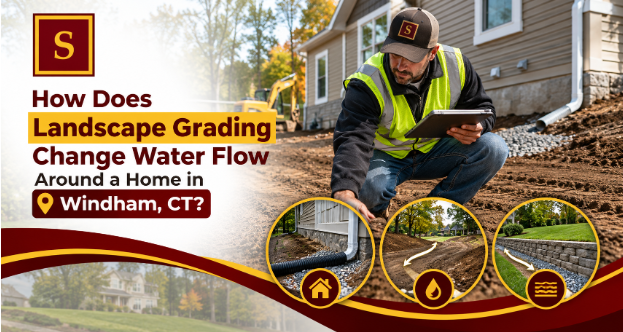
When homeowners think about improving their yard, grading may not be the first project that comes to mind. Many people focus on landscaping, patios, driveways, or gardens without realizing that the shape and slope of the ground can have a major effect on where rainwater goes.
Landscape grading is the process of shaping or adjusting the ground so water flows in a more controlled direction. Around a home, proper grading can help move water away from the foundation and reduce areas where rainwater collects. For homeowners in Windham, CT, understanding how grading affects water flow can be especially useful when dealing with wet yards, erosion, or recurring drainage problems.
What Is Landscape Grading?
Landscape grading involves changing the elevation or slope of the soil on a property. The goal is not necessarily to make the entire yard completely flat. Instead, the ground is shaped to create a more useful and controlled flow of water.
Rain naturally follows the path of least resistance. If the ground slopes toward a house, water may collect around the foundation. If low areas are present in the yard, water can remain there long after a storm.
Proper grading changes these conditions by creating slopes that help guide water toward appropriate drainage areas.
Why Does Water Flow Matter Around a Home?
Water that is not properly directed can create several property problems. Standing water can make parts of a yard difficult to use and may contribute to soil erosion or muddy conditions.
Water collecting close to the foundation is another concern. Repeated exposure to moisture around a home’s foundation can contribute to drainage problems and may eventually affect areas such as basements or crawl spaces.
This does not mean that grading alone solves every water problem. Drainage systems, soil conditions, gutters, downspouts, and the property’s overall layout can also influence how water moves.
How Does Grading Move Water Away From the House?
A properly graded yard creates a gradual slope that encourages water to move away from structures rather than toward them.
Imagine a yard where the soil rises toward the house and drops toward the street or another suitable drainage area. When rain falls, gravity naturally carries the water downhill.
Now imagine the opposite situation. If the ground slopes toward the house, rainwater may move directly toward the foundation. Even if the problem is not obvious during light rainfall, heavy storms can make it much more noticeable.
This is why the direction of the slope is an important part of property planning.
What Happens When a Yard Has Low Spots?
Low spots are areas where the ground sits lower than the surrounding landscape. These areas can collect rainwater because water naturally flows toward them.
You may notice a low spot if a section of your lawn remains wet while the rest of the yard dries. Mud, standing water, thinning grass, or repeated erosion can also indicate that the property’s current grade is not directing water effectively.
Depending on the property, correcting the elevation of the low area may improve drainage. However, the cause of the water problem should be understood before soil is simply added or moved.
How Can Grading Affect the Foundation?
One of the main reasons homeowners consider landscape grading is to manage water around the home.
If soil slopes toward a foundation, rainwater can repeatedly collect in the same area. A grading plan can reshape the surrounding ground so surface water has a better path away from the structure.
Homeowners should also check whether gutters and downspouts are directing roof water into areas that already have drainage problems. Even a properly graded yard can struggle if large amounts of concentrated water are discharged next to the foundation.
Can Grading Help With Yard Erosion?
Yes, grading can play a role in reducing certain types of erosion.
When rainwater moves quickly over exposed soil, it can carry soil particles downhill. Over time, this can create channels, washouts, bare areas, and uneven sections of the yard.
Proper grading can help control the direction and movement of surface water. In some properties, additional measures such as drainage systems, vegetation, stone, or other erosion-control solutions may also be appropriate.
The right approach depends on the property’s slope, soil, water volume, and existing drainage conditions.
What Does Soil Have to Do With Water Flow?
Soil conditions can significantly affect drainage. Some soils allow water to move through them relatively easily, while others can hold water for longer periods.
Compacted soil can also affect how rainwater moves across a property. Instead of soaking into the ground, water may run across the surface and collect in lower areas.
Before changing the grade, it is useful to understand the existing soil and drainage conditions. Moving soil without addressing the underlying cause may not provide a lasting solution.
When Might a Home Need Regrading?
There are several signs that may indicate a property needs to be evaluated for grading problems:
- Water repeatedly collects in the same area.
- The yard stays muddy after rain.
- Soil is washing away from sloped areas.
- Water flows toward the house.
- A lawn has persistent low spots.
- Parts of the property are difficult to use because of uneven ground.
- Drainage problems continue despite functioning gutters and downspouts.
These signs do not automatically mean that regrading is necessary. A property should be evaluated to determine what is causing the water issue and whether grading is an appropriate solution.
How Does Grading Fit Into Construction Projects?
Grading is not limited to existing lawns. It can also be important when preparing a property for construction.
New driveways, additions, patios, retaining walls, drainage improvements, and other outdoor projects may change how water moves across a property. Planning the grade before construction can help prevent a new feature from unintentionally directing water toward another part of the yard or home.
- Kyle Stearns Contracting provides landscape grading along with excavation, drainage, septic, and hardscaping services throughout Central and Eastern Connecticut. The company’s site explains that grading can improve drainage, reduce erosion, protect foundations, and create level areas for construction.
When Should You Consider Professional Grading?
If a drainage problem keeps returning, it is useful to look at the entire property rather than treating only the visible puddle.
A professional can evaluate the property’s elevations, slopes, soil conditions, existing drainage, structures, and surrounding landscape. This can help determine whether grading, drainage work, or a combination of solutions is appropriate.
For property owners researching Outdoor construction excavation Storrs Windham, CT, understanding how excavation and grading work together can also help when planning larger outdoor projects.
Good Grading Starts With Understanding Water
Landscape grading is essentially about giving water a better path to follow. When the ground is shaped appropriately, rainwater can move away from buildings, reduce unnecessary pooling, and flow toward suitable drainage areas.
For homeowners in Windham, CT, this can be an important consideration when dealing with wet lawns, erosion, foundation-area water, or an uneven property.
The key is to identify the reason water is collecting before changing the landscape. In some cases, grading may be enough. In others, drainage improvements or additional site work may be needed. Understanding the property’s water flow first can help homeowners make a more informed decision about what their yard actually needs.