- 2 Stearns Road
- Storrs CT 06268
- Business Hours
- Mon-Fri : 7am To 5pm

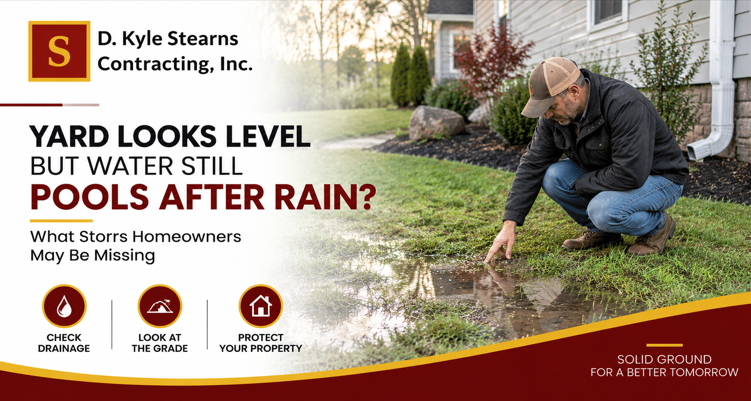
A yard can look perfectly level on a dry, sunny day but tell a very different story after heavy rain. You may notice puddles that remain for hours or days, soggy patches near the house, water collecting beside a walkway, or sections of lawn that never seem to dry properly.
For Storrs homeowners, standing water is more than an appearance issue. It can make parts of the yard difficult to use, contribute to muddy conditions, affect landscaping, and sometimes indicate that water is not moving through the property as intended. Understanding why pooling happens is the first step toward finding the right solution.
A Yard Can Look Level Without Draining Properly
One of the biggest misconceptions about drainage is that a yard should be completely flat.
In reality, outdoor areas often need subtle changes in elevation to guide rainwater toward appropriate drainage areas. These changes may be difficult to see with the naked eye. A section of lawn that appears level could contain a shallow low spot where water naturally collects.
Professional grading considers these small elevation differences and how water moves across the entire property rather than simply whether the lawn looks flat.
Kyle Stearns provides excavation, grading, drainage, septic, and related site-work services, all of which can play a role in how water moves around a property.
Small Low Spots Can Hold a Surprising Amount of Water
Water naturally follows gravity and settles in lower areas.
Even a relatively shallow depression can collect significant water during a heavy Connecticut rainstorm. These low spots may develop because of soil settlement, previous construction, landscaping changes, vehicle traffic, or years of normal ground movement.
Watch your yard while it is raining if it is safe to do so. Seeing where water travels can reveal much more than looking at the property after everything has dried.
Check Where Downspouts Release Water
Sometimes the yard itself is not the main source of the problem.
Roof gutters collect a large amount of rainwater and direct it through downspouts. If a downspout releases water into a low area or too close to a problem section of the yard, that location may become saturated quickly.
Look at where each downspout ends and observe the direction the water travels. If water immediately moves toward the house, patio, driveway, or an existing puddle, drainage around that area may deserve closer attention.
Soil Conditions Affect How Quickly Water Disappears
Two yards with similar slopes can behave very differently after the same storm.
Soil composition and compaction influence how quickly water can soak into the ground. Heavily compacted soil may absorb water slowly, causing rainfall to remain on the surface longer. Construction equipment, repeated vehicle traffic, and previous site work can all contribute to compaction.
This is why simply adding soil to a wet area may not solve the underlying problem. The reason the water is collecting should be understood before making significant changes.
Landscaping Can Change Drainage Patterns
New landscaping can unintentionally change where water goes.
Raised planting beds, retaining walls, patios, walkways, sheds, and other improvements can interrupt an existing drainage path. Adding soil around one section of the property may also redirect runoff toward another area.
A yard that never had drainage trouble can therefore begin developing puddles after an outdoor project. When planning Outdoor construction excavation Storrs Windham, CT, considering existing drainage before changing elevations or disturbing soil can help homeowners understand how the finished project may affect water movement.
Pay Attention to Water Near the Foundation
Pooling in the middle of an open lawn can be inconvenient, but standing water close to the home deserves particular attention.
The ground around a house generally needs to manage runoff so water does not continually collect beside the foundation. If puddles repeatedly form near basement walls, entryways, or foundation areas, look at the surrounding grade, downspouts, and drainage patterns.
Water near a foundation does not automatically mean there is structural damage. However, repeated pooling is worth investigating rather than treating it as a normal part of rainy weather.
Don’t Assume More Drainage Pipe Is Always the Answer
When homeowners see standing water, installing a drain may seem like the obvious solution.
Drainage systems can be useful in appropriate situations, but a pipe cannot correct every problem. Sometimes the issue is surface grading. In other situations, downspout discharge, compacted soil, a blocked drainage path, or landscaping changes may be contributing.
The right solution depends on where the water originates, where it collects, and where it can safely be directed.
Observe the Yard Before Making Changes
Before bringing in additional soil or starting another landscaping project, document what happens during several rain events.
Take photos of puddles, note how long they remain, and observe whether water is flowing from the roof, driveway, neighboring areas, or higher sections of your property. Also note whether the problem developed after recent construction or landscaping.
This information can make it easier to understand the pattern instead of simply treating the most visible puddle.
Final Thoughts
A Storrs yard can appear level and still have drainage problems that become obvious only during heavy rain. Small elevation changes, compacted soil, downspouts, landscaping, and previous construction can all influence where water travels and how long it remains.
Instead of repeatedly filling puddles or assuming a drain is automatically needed, look at the property as a complete system. Understanding where the water comes from and why it collects can help determine whether grading, drainage improvements, excavation, or another approach makes sense.